SCIENCE & THE FUTURE | CURIOFY LIFE
Imagine needing a new kidney and, instead of spending years waiting for a donor, doctors could grow a replacement from living cells.
No waiting list. Perhaps fewer problems with immune rejection. An organ designed to work with your own body.
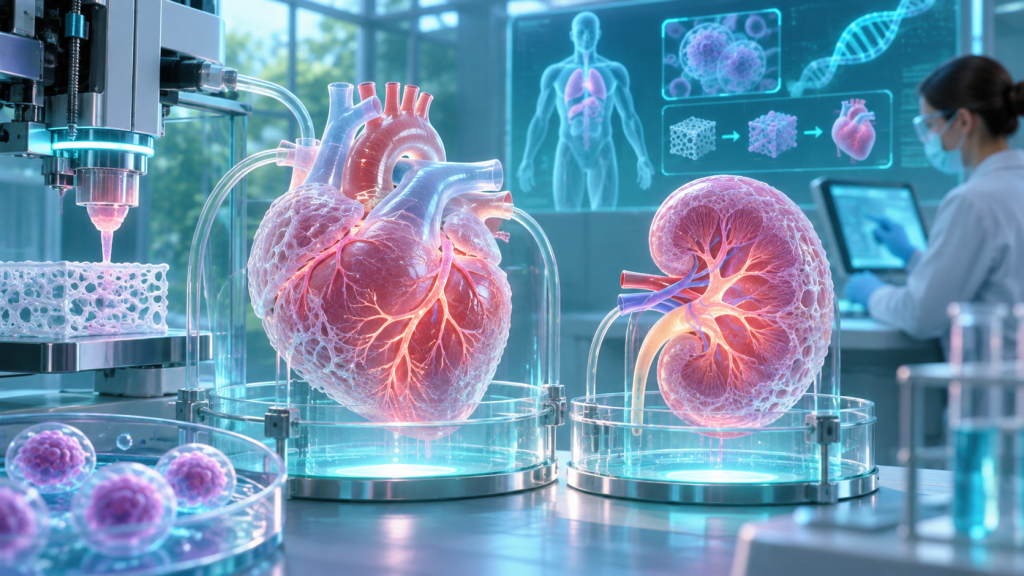
It sounds like science fiction. But in laboratories around the world, researchers are already growing human tissues, creating miniature organ-like structures, and testing ways to repair organs that once seemed beyond repair.
So can scientists really grow new human organs? The answer is both more exciting—and more complicated—than a simple yes. We can engineer certain tissues and restore some lost biological functions. We cannot yet routinely grow a fully functional human heart, kidney, or liver for transplantation.
1. Your Body Is Already a Regeneration Machine
Every day, your body replaces worn-out cells and repairs countless tiny injuries. Skin heals after a cut. The intestinal lining continually renews itself. After part of the liver is removed, the remaining liver can regrow much of its lost mass and function.
But regeneration has limits. Heart muscle damaged by a major heart attack is often replaced by scar tissue. Human kidneys generally cannot rebuild all their lost filtering units. And when an entire organ fails, the body’s natural repair systems may not be enough.
Regenerative medicine aims to change that—by supplying cells, building replacement tissue, or helping the body repair itself.
2. The Four Technologies Behind the Revolution
- Stem cells: Some can develop into many specialized cell types. Researchers use carefully controlled conditions to guide them toward cells found in organs such as the pancreas, heart, or kidney.
- Organoids: Tiny three-dimensional clusters of cells that reproduce selected features of an organ. They are valuable for studying development, disease, and drug responses, but they are not miniature transplant-ready replacements.
- Tissue engineering: Scientists grow cells on or within supportive materials called scaffolds. The scaffold helps shape the tissue and can guide its organization.
- 3D bioprinting: Specialized printers position living cells and biological materials in planned patterns, potentially creating layers and structures that conventional tissue culture cannot easily produce.
These methods often work together. But placing living cells in the shape of an organ is only the beginning. The result must survive, connect to the body, and perform its job reliably.
3. What Has Actually Worked in People?
Some engineered tissues are already part of real medicine. In the United States, the FDA has approved MACI, a treatment that uses a patient’s own cartilage cells grown on a collagen membrane to repair certain knee cartilage defects. This is a genuine example of laboratory-expanded cells being used to rebuild tissue—not a replacement knee joint.
Another important milestone came in December 2024, when the FDA approved SYMVESS, an acellular tissue-engineered blood vessel for a specific type of severe limb artery injury when an appropriate vein graft is not feasible. It is a manufactured vascular conduit, not an entire lab-grown organ.
Researchers have also explored more ambitious procedures. In a small study published in The Lancet in 2006, surgeons implanted tissue-engineered bladder constructs in seven patients undergoing bladder reconstruction. It was an important proof of concept, but it did not establish routine availability of complete lab-grown replacement bladders.
The distinction matters: repairing cartilage, implanting an engineered vessel, and rebuilding part of a bladder are impressive achievements. They are not proof that scientists can already manufacture any organ on demand.
4. A Remarkable Step Toward Restoring Pancreatic Function
One of the most compelling advances comes from type 1 diabetes. In this disease, the immune system destroys the insulin-producing beta cells in the pancreas.
Instead of growing an entire new pancreas, scientists are testing whether they can replace the missing cell function.
In a phase 1–2 clinical study published in 2025, researchers transplanted stem-cell-derived islet cells into people with type 1 diabetes. Among 12 participants given the full dose and followed for a year, 10 were insulin-independent at day 365. All 12 met the study’s reported measures for freedom from severe hypoglycemic events and blood-sugar control during the assessment period.
That is a striking result. But there are essential qualifications: the study was small, follow-up was limited, participants received immune-suppressing drugs, and safety and durability still need investigation. This treatment was experimental—not an established cure for type 1 diabetes.
Even so, it points toward an intriguing possibility: sometimes medicine may restore an organ’s function without replacing the whole organ.
5. Tiny Organs in a Dish—and a Big Breakthrough
Organoids look almost magical under a microscope. Researchers can grow miniature structures that resemble aspects of intestines, lungs, brains, kidneys, and other tissues.
Their immediate value is often in research: scientists can observe disease processes, screen potential medicines, and study human development in ways that would otherwise be difficult.
In 2025, NIH highlighted research in which laboratory-grown lung and intestinal organoids developed specialized blood-vessel structures. That’s an important advance because living tissue needs a supply of oxygen and nutrients.
However, a microscopic organoid with some blood vessels is not the same thing as a fully connected, adult-sized organ that could be transplanted into a patient.
6. Why Scientists Cannot Simply Print a New Kidney
Consider what a functioning kidney must do. It filters blood, balances water and salts, helps regulate blood pressure, and produces hormones. It contains intricate networks of blood vessels, filtering units, and drainage pathways that must work together.
A 3D printer might recreate part of the kidney’s shape, but shape is not function. The cells must mature into the correct types and arrange themselves with microscopic precision. Blood must circulate through the tissue without damaging it. Urine must drain. And the whole system must keep working safely for years.
The heart poses different challenges: organized muscle, electrical coordination, valves, and a blood supply. The liver must carry out many metabolic tasks simultaneously.
A 2026 review in Nature Biotechnology describes major barriers to engineering replacement kidney tissue, including inconsistent results, missing cell types, immaturity, and difficulty scaling up production.
Then there is the immune system. Cells taken from another person may be rejected. Cells derived from a patient’s own tissues could reduce some compatibility problems, but producing them safely, reliably, and affordably introduces other challenges.
7. Could Artificial Intelligence Help Build the Next Organ?
This is where regenerative medicine meets another Curiofy Life fascination: artificial intelligence.
AI can help researchers analyze microscope images, identify cell states, compare experimental designs, model molecular interactions, and explore which materials or growth conditions might produce better tissues.
It might also improve quality control: identifying when a growing tissue deviates from the intended structure or when some cells appear abnormal.
But AI cannot substitute for biology or clinical testing. A computer-generated design still has to become living tissue, and any implant must prove safe and effective in rigorous studies.
The most realistic promise is AI helping scientists conduct better experiments and find useful solutions faster—not a machine instantly printing ready-to-use organs.
8. The Road Ahead: Progress Without a Promised Deadline
What might happen next? Engineered patches, more sophisticated blood vessels, cell-based treatments, and organoid-guided drug research are plausible areas for continuing progress. Some are already being studied in patients; others remain preclinical.
A future in which hospitals routinely grow full replacement organs would require major advances in blood-vessel networks, tissue maturation, immune compatibility, manufacturing, cost, and long-term safety.
Researchers cannot responsibly give us a reliable date when transplant-ready lab-grown hearts or kidneys will become routine care. And anyone offering an unapproved ‘regenerated organ’ treatment today deserves careful scrutiny.
For now, the question is not simply whether scientists can grow human cells. They clearly can. The harder question is whether they can assemble those cells into a safe, durable, fully functioning organ.
The Curiofy Life Perspective
There is something extraordinary about the direction of this research. Medicine is beginning to move beyond treating damaged organs toward repairing tissues and, in some cases, replacing the cells responsible for essential functions.
The dream of growing a new kidney or heart is still a dream. Yet the real advances are meaningful precisely because they are measurable—not because they sound futuristic.
One engineered vessel. One repaired cartilage defect. One promising clinical trial. Each becomes another piece of the puzzle.
And perhaps one day, those pieces will help make the impossible possible.
Explore. Discover. Live Better.
Research and Further Reading
- U.S. FDA: MACI engineered cartilage treatment
- U.S. FDA: SYMVESS tissue-engineered vessel
- New England Journal of Medicine (2025): Stem-cell-derived islets for type 1 diabetes
- NIH (2025): Organoids with specialized blood vessels
- Nature Biotechnology (2026): Developmentally inspired kidney engineering
- The Lancet (2006): Tissue-engineered bladder reconstruction study
Curiofy Life explores emerging science for educational purposes. This article does not provide personal medical advice or recommend experimental stem-cell or organ-regeneration treatments.


Leave a Reply