LIFE & DISCOVERY | CURIOFY LIFE
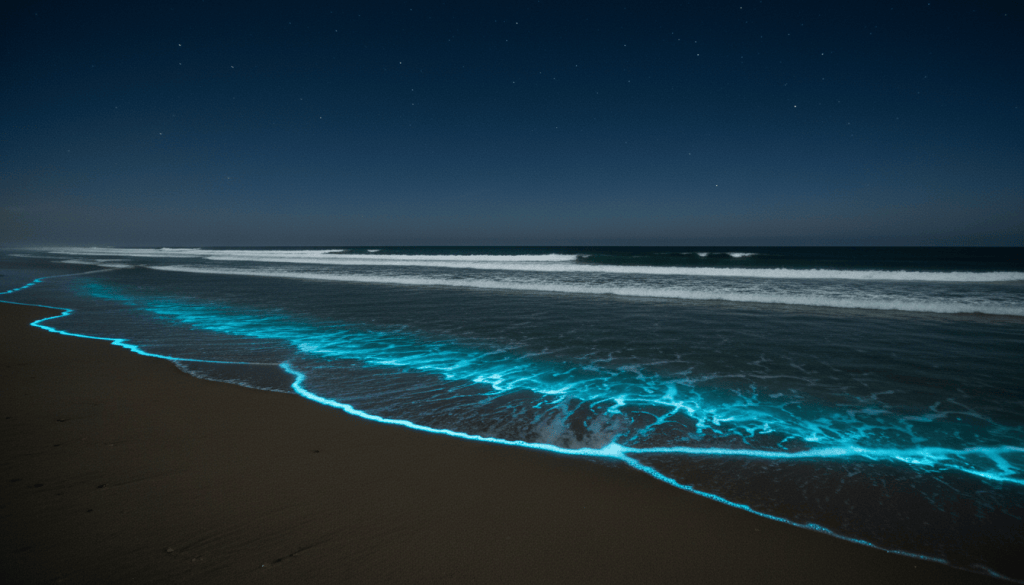
Picture standing on a dark beach. A wave rolls toward you—and its breaking edge suddenly flashes brilliant electric blue.
It looks like a scene from a science-fiction movie. But in certain parts of the world, that dazzling light comes from an extraordinary natural process: living organisms making their own glow.
The phenomenon is called bioluminescence. It has fascinated people for centuries, but modern biology can explain much of what is happening inside those waves.
1. The Ocean Is Full of Living Lights
According to the National Oceanic and Atmospheric Administration (NOAA), bioluminescence is light made by living organisms through chemical reactions. It appears in different kinds of marine life, from bacteria and jellyfish to fish and microscopic plankton.
A glowing shoreline is often the combined effect of huge numbers of tiny organisms. Each individual flash may be small, but together they can outline an entire wave.
2. Meet the Microscopic Plankton Behind the Glow
The Scripps Institution of Oceanography explains that certain dinoflagellates—single-celled plankton—can form dense blooms in coastal waters. In Southern California, a bioluminescent species responsible for many displays is known as Lingulaulax polyedra, previously called Lingulodinium polyedra.
When the organisms are abundant, they can make the ocean appear reddish or brownish in daylight. Yet after sunset, movement in the water can trigger intense blue flashes.
Not every bloom glows. Different plankton species behave differently, and many shoreline blooms produce no visible bioluminescence at all.
3. Why Does a Breaking Wave Make Them Flash?
Bioluminescent dinoflagellates can emit light when water movement disturbs them. Imagine the mechanical force of a breaking wave passing through millions of tiny cells. Their responses can make the wave’s advancing edge look illuminated from within.
Scientists suspect some of these flashes function as defense mechanisms, potentially startling would-be predators or attracting larger animals that threaten them. As Smithsonian Ocean explains, marine bioluminescence serves a variety of purposes across different organisms, and not all of those functions are fully understood.
4. The Chemistry of a Blue Spark
Bioluminescent systems use chemical reactions that release energy as visible light. A molecule called luciferin and proteins that help catalyze or regulate the reaction are involved in many species, although the exact chemistry varies across organisms.
The Smithsonian’s ocean science team notes that blue light travels comparatively far through seawater. Many marine organisms therefore produce blue or blue-green light, though nature also contains other colors of bioluminescence.
This is genuine light generated by life, not merely moonlight reflecting off a wave. It also differs from biofluorescence, in which an organism absorbs light and re-emits it at another wavelength.
5. Is a Glowing Beach Safe to Swim In?
Beautiful does not automatically mean harmless. Some dinoflagellate blooms are associated with toxins or other compounds that can affect marine animals and people. A luminous wave does not identify the species present or establish that the water is safe.
NOAA’s harmful algal bloom guidance describes potential risks from certain bloom-forming species. Scripps also notes that red-tide events vary widely; some are harmful, others are not. Always follow local beach closures and public-health advisories, and avoid assuming that a dramatic night-time display is an invitation to swim.
6. Can You Predict When the Ocean Will Glow?
There isn’t a guaranteed calendar for a spectacular glowing shoreline. The appearance depends on plankton populations, local conditions, water movement, and the timing of a bloom.
Scripps advises that events can be unpredictable. Dark conditions may make the light easier to see, but even a good viewing location cannot guarantee a display on a particular night.
And if you go to watch, remember that shorelines at night carry ordinary hazards: waves, currents, unstable footing, and poor visibility.
7. The Curiofy Life Perspective
The next time you see footage of a glowing blue sea, remember what makes it remarkable: billions of tiny living systems responding to the physics of a moving wave.
If you love unexplained-looking natural wonders with real scientific explanations, try The Universe We Can’t See next. Or read Why Time Seems to Speed Up as We Get Older for another mystery hiding in everyday experience.
Explore. Discover. Live Better.
Sources & Further Reading
These institutional and scientific sources support the key claims in this original article.
- NOAA: What Is Bioluminescence?
- Scripps Institution of Oceanography: Red Tides and Bioluminescence
- Smithsonian Ocean: Bioluminescence
- NOAA: Harmful Algal Blooms
Keep Exploring Curiofy Life
More stories: browse this Curiofy Life category.


Leave a Reply