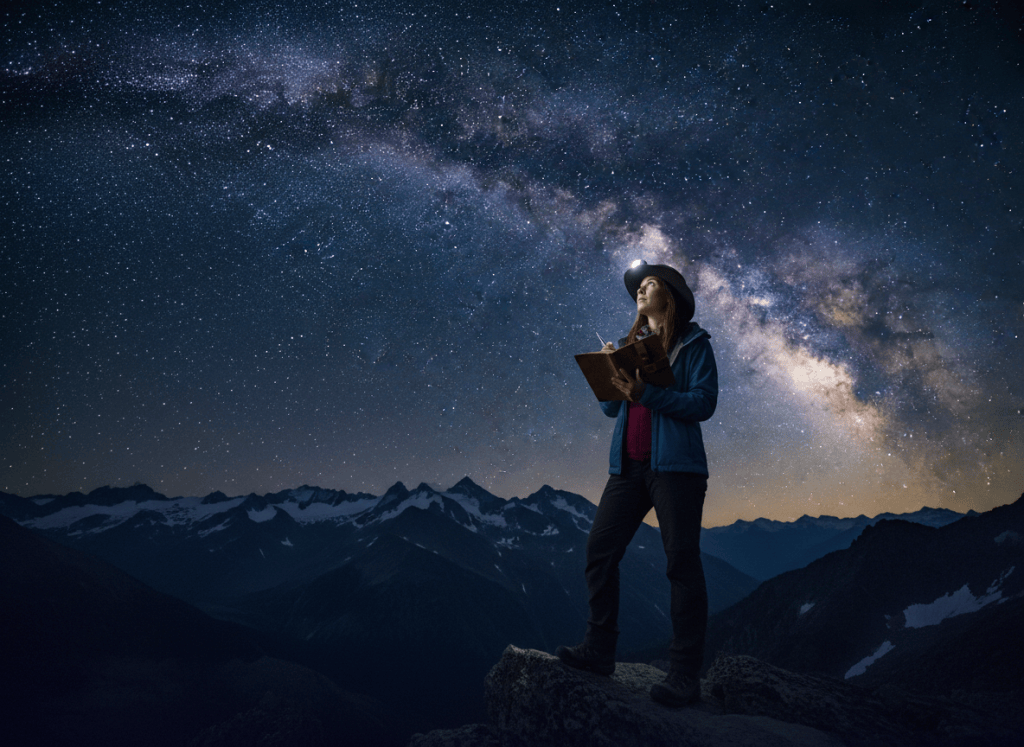
Tonight, step outside and look up. On a clear, dark night, the sky seems filled with tiny points of light, steady reminders that the universe is much bigger than our everyday lives. But a Curiofy Life reader raised a question that changes the way we look at every one of them: What if some of those stars are no longer there?
It sounds like science fiction. It isn’t. The light reaching your eyes tonight may have begun its journey long before you were born. And yet the surprising answer is more reassuring—and more interesting—than the popular claim that the night sky is full of dead stars.
The night sky isn’t a live broadcast
Light moves astonishingly fast: about 186,000 miles per second. But space is so vast that even light needs time to cross it. Sunlight takes roughly eight minutes to reach Earth. The light from a star 100 light-years away has been traveling for 100 years.
That is what a light-year means: a distance, not a length of time. When you see a star 100 light-years away, you see it as it appeared a century ago—not necessarily as it is right now.
The closest star beyond our Sun, Proxima Centauri, is about 4.2 light-years away, although it’s too faint to see with the naked eye. Even our nearest stellar neighbor sends us news that is more than four years old.
So are the stars we see already dead?
It’s possible for a star to die before the news reaches us. But most of the stars you can see without a telescope are very likely still alive.
Why? Many naked-eye stars are within about 1,000 light-years of Earth, while stars typically live for millions to billions of years. Some small stars can shine for far longer. A few centuries—or even a few thousand years—are usually a tiny fraction of a star’s lifetime.
That doesn’t mean astronomers can tell us what every star is doing at this exact instant. It means that, based on how stars evolve, it’s unlikely that most of the familiar lights overhead have already gone out.
Meet a star whose future is written in suspense
Look for Orion on a clear night. The reddish star marking one of the hunter’s shoulders is Betelgeuse, a huge, aging star roughly 700 light-years away. The light you’re seeing left it centuries ago, long before the first modern telescopes.
Betelgeuse is expected to end its life in a spectacular supernova someday. Astronomers study its changing brightness and behavior, but no one knows exactly when that final explosion will happen. If it has occurred already and the light has not reached us, we would not yet know. That is a possibility—not a discovery.
The extraordinary part is that Betelgeuse does not have to be dead for the story to be remarkable. Every glance at it is a glimpse of an earlier chapter in a real star’s life.
We’ve already watched a star’s death arrive late
In the year 1054, observers in China recorded a bright new ‘guest star’ in the sky. We now connect that event with the supernova that produced the Crab Nebula, the glowing remnant of a star that exploded thousands of light-years away.
The explosion itself happened long before anyone on Earth saw it. Only when its light finally arrived did people witness the event. The star’s final moment became visible to us across an enormous gulf of time.
And the farther we look, the deeper into history we go
The Andromeda galaxy is about 2.5 million light-years away. When we observe its glow, we’re seeing light that departed roughly 2.5 million years ago. Powerful space telescopes look even farther away, revealing galaxies as they existed billions of years in the past.
Astronomy has a peculiar gift: it allows us to study history without digging into the ground or opening a book. The universe brings its own ancient records straight to us, carried by light.
The next time you look up
Think of the night sky as a collection of messages with different travel times. Some are only years old. Others began their journeys before entire chapters of human history unfolded.
Most of those stars are probably still shining. But none of us sees them in perfect real time. We live beneath a sky made of the past—and that makes every clear night a chance to look into history.
Here’s a question to take outside tonight: If the stars above us are showing us yesterday, what might the universe be doing right now that we won’t discover for another thousand years?
Keep exploring: The Universe We Can’t See: Five Mysteries Hidden in the Night Sky.
Sources and further reading
NASA: Time Travel—Observing Cosmic History
NASA: Stars and Their Life Cycles
European Southern Observatory: How Far Away Are the Stars?
American Museum of Natural History: Stargazing, Looking Back in Time


Leave a Reply