Imagine discovering that almost everything you can see in the night sky is only a small fraction of the matter that actually exists. Not because our telescopes are too weak. Not because it is hiding behind distant stars. But because the rest appears to give off no light at all.
We call that unseen component dark matter. Astronomers estimate that it accounts for roughly 85% of all matter in the cosmos. Yet after decades of searching, nobody can say with certainty what it is made of.
And in September 2026, an experiment nearly a mile underground reported an unusual event that could become part of the answer. The scientists themselves are being careful: it is a clue, not a discovery.
The galaxy that should not behave this way
Picture the Milky Way as a vast, spinning city of stars. Astronomers can measure how quickly stars orbit its center. Far from the center, many stars move faster than the gravity of visible stars and gas alone would predict.
That was one of the great puzzles behind the modern dark-matter idea: either galaxies contain substantial invisible mass, or our understanding of gravity needs changing. Measurements from galaxies, galaxy clusters and the early universe have increasingly supported a picture in which ordinary matter is surrounded by large halos of unseen mass.
Dark matter does not appear to emit, absorb or reflect light. That is why even the most powerful telescope cannot simply photograph the substance itself. But its gravity can leave a visible fingerprint.
How do you see something invisible?
One of the most remarkable clues comes from gravitational lensing. Mass bends the path of light traveling past it. By looking at how distant galaxies appear stretched or distorted, researchers can estimate how much mass lies in the foreground—even when that mass is not glowing.
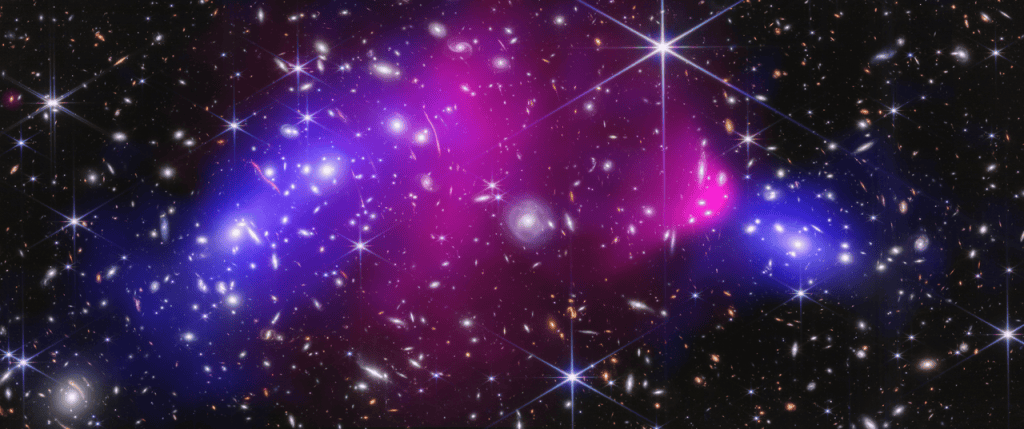
The famous Bullet Cluster adds another piece of evidence. After two galaxy clusters collided, the hot, ordinary gas slowed and piled up, while the strongest gravitational mass concentrations were mapped in different locations. This separation is difficult to explain if all the gravity comes from the gas we can observe.
The patterns in the cosmic microwave background—the ancient light left over from the early universe—also help scientists calculate the amount of ordinary and non-ordinary matter needed to describe cosmic history.
These measurements are becoming more powerful as new surveys grow. For example, the European Space Agency’s Euclid telescope is building a vast map of galaxies and their gravitational distortions. Read our companion story: 900 Million Galaxies: What Euclid’s New Cosmic Map Could Reveal.
So what is dark matter made of?
That is the question nobody can answer yet. The leading possibilities include new types of particles that are absent from our current catalog of familiar matter.
WIMPs (weakly interacting massive particles) are hypothetical heavy particles that might pass through ordinary matter almost unnoticed. Axions are another proposed possibility: extremely light particles that could collectively account for enormous amounts of invisible mass. Scientists are also exploring other candidates and testing whether some of the observations could reflect gaps in theories of gravity.
Dark matter is not the same thing as dark energy. Dark energy is the name given to whatever is driving the universe’s accelerated expansion. The commonly used cosmic breakdown is approximately 5% ordinary matter, 27% dark matter and 68% dark energy, measured as shares of the universe’s total mass-energy. The 85% figure refers only to the matter portion.
A strange signal from deep underground
Now the story gets especially interesting. On September 1, 2026, the LUX-ZEPLIN (LZ) collaboration announced that a new analysis had found one unusual particle interaction in its liquid-xenon detector, installed deep underground in South Dakota to shield it from interfering radiation.
The event was identified in data collected in 2023 and analyzed for a wider range of possible particle interactions before the result was announced in September 2026. It occurred in a region where researchers expected very little background activity. Their analysis reached 2.6 sigma, short of the conventional 5-sigma discovery standard. It could fit certain dark-matter particle scenarios, but a single event cannot establish what caused it. More data—and ideally independent confirmation—are essential.
That distinction matters. A tantalizing signal can lead to a breakthrough, or it can disappear once a larger dataset reveals an overlooked source of background noise. Science advances by testing both possibilities.
Why this mystery matters to us
Dark matter may have helped shape the cosmic scaffolding into which galaxies formed. Understanding it could teach us whether the universe contains an entirely new family of particles and whether our best physical theories are missing a major ingredient.
The extraordinary part is not simply that scientists have a mystery. It is that many different measurements, made in very different ways, point toward an unseen gravitational component—while the identity of that component remains unresolved.
We have learned to map its effects across billions of light-years. We have not yet learned what it is.
A Curiofy Life reader recently asked a simple question: What is dark matter made of? The answer, for now, might be the most interesting three words in science: We don’t know. But we are getting better at knowing where—and how—to look.


Leave a Reply