
Scientists have used artificial intelligence to design viruses that attack bacteria. The breakthrough could eventually help fight difficult infections—but there is a long road from a laboratory result to a lifesaving treatment.
Imagine arriving at a hospital with a dangerous bacterial infection. The doctors have antibiotics—but the bacteria aren’t responding. One medicine fails. Then another.
Now imagine your doctor has a very different weapon: a virus. Not a virus that makes you sick, but one that attacks the bacteria causing the infection. And here’s the extraordinary possibility: artificial intelligence could help scientists design that virus.
That future isn’t here yet. But a striking experiment suggests it may be worth pursuing.
The viruses that hunt bacteria
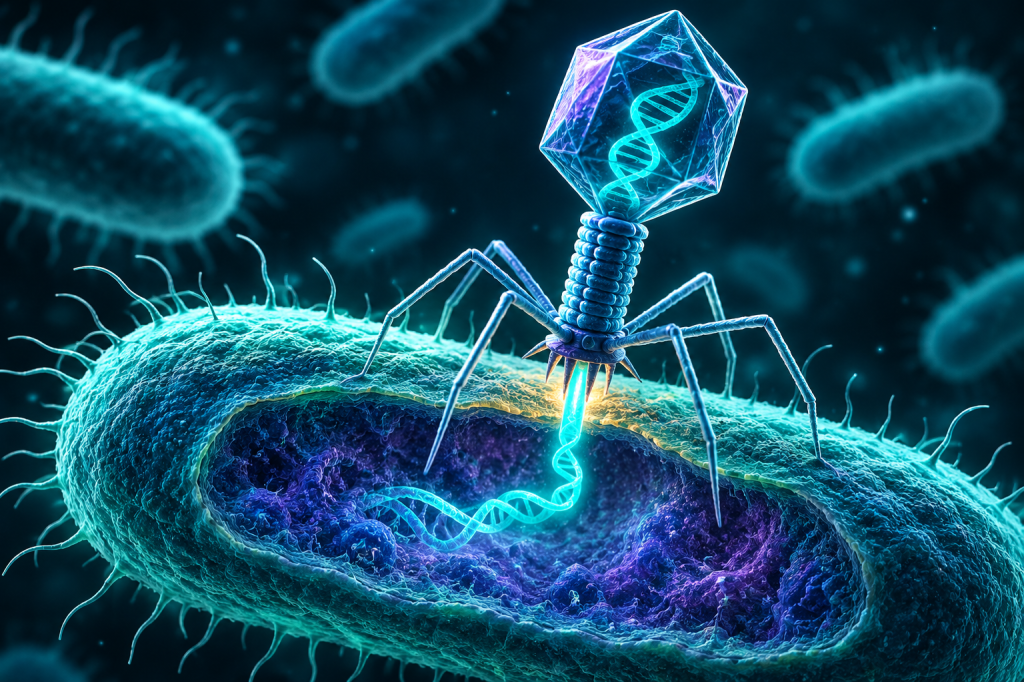
When most of us hear virus, we think of influenza, COVID-19, or another illness. But some viruses—called bacteriophages, or phages—infect bacteria instead of human cells.
A phage can attach to a susceptible bacterium and deliver its genetic material. Certain phages then use the bacterium’s machinery to make copies of themselves, eventually bursting the cell.
Scientists have studied phages for more than a century. Phage therapy has a long history, but its availability, clinical evidence, and regulatory status vary. One challenge is matching the right phage to the right bacterial strain.
Teaching AI to write genetic instructions
Researchers at Stanford University and the Arc Institute used a genome language model called Evo 2 to propose new bacteriophage DNA sequences. Unlike a chatbot trained on words, a genome model learns patterns in biological sequences.
They focused on a well-studied phage called ΦX174, which infects certain E. coli strains. After generating candidate designs, scientists synthesized and tested them in the laboratory.
Sixteen AI-designed phages proved functional in the experiments. These were not merely computer predictions: the team produced biological viruses that worked in laboratory conditions. Some outperformed the reference phage under specific tests.
Even more intriguingly, combinations of the designed phages helped overcome resistance in laboratory bacteria that resisted the original phage.

Why antibiotic resistance matters
Bacteria can evolve resistance to medicines, making some infections increasingly difficult to treat. Phages offer a different approach because they can be highly specific to bacterial targets.
But bacteria can also evolve resistance to phages. The researchers’ results suggest that designing and combining phages may be a promising avenue to investigate—not that AI-designed viruses can already replace antibiotics.
Could an AI-designed virus actually save a life?
Possibly, someday. But this study did not demonstrate a cure in humans. Its major achievement was showing that AI-designed viral genomes could produce working phages in laboratory experiments.
Before any such therapy becomes established, researchers must investigate whether it reaches an infection, attacks the intended bacteria, avoids unwanted effects, withstands the immune response, and performs safely and reliably in people. Manufacturing consistency, regulatory review, and responsible safeguards for biological design also matter.
A surprising new partnership
For decades, computers helped researchers analyze biology. Now AI may also help them propose new biological designs for careful experimental testing. Human scientists remain essential: they choose the questions, run the experiments, verify the results, and assess the risks.
Perhaps the most surprising twist is that a virus—something we’ve spent generations learning to fear—might one day become part of the solution to dangerous bacterial infections.
The future of fighting bacteria may involve designing better viruses to fight them.
Stay Curious. Live Better.
Sources and further reading
- King and colleagues, “Generative design of bacteriophages with genome language models,” Science (2026)
- Stanford University: AI designs a novel E. coli killer
- PubMed research record
Editorial note: The findings concern experimental research, not an available or proven AI-designed phage treatment for patients.


Leave a Reply