A data center and a neighborhood can have opposite problems on the same winter morning. The servers need to shed heat. The people next door are paying to make it. What would it take to send some of that heat across the street?
In Odense, Denmark, part of the answer is already running through pipes. The local utility, Fjernvarme Fyn, uses heat recovered from a Meta data center to supply the city’s district heating network. The engineering starts with a familiar question for anyone who works on heating equipment. How warm is the water you have, and how warm does it need to be?
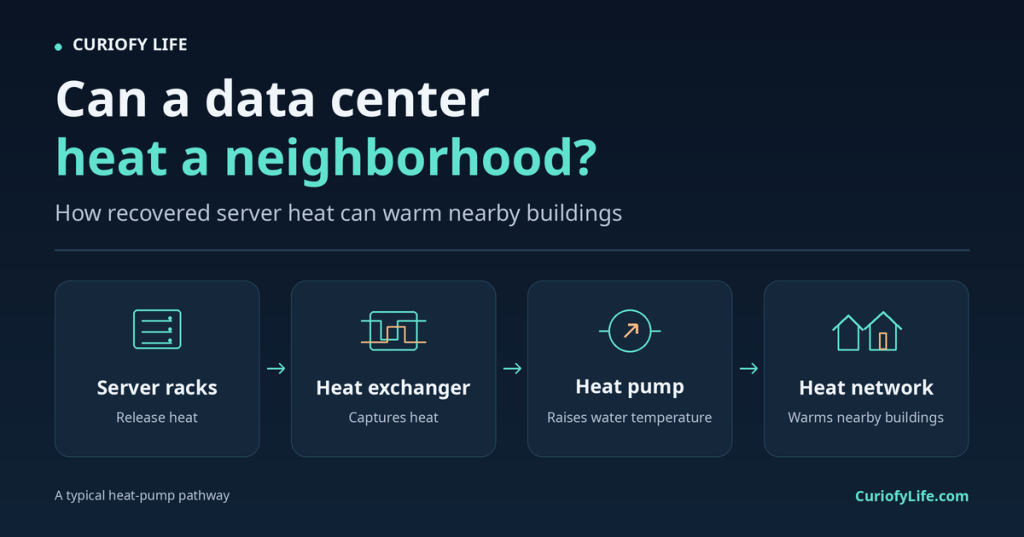
The servers supply the heat. The heat pump makes it useful.
As the servers run, the electricity they use ends up mostly as heat. A data center normally moves that heat away from its equipment and releases it. With heat recovery, an exchanger transfers some of that heat into a water loop that carries it to a customer or to another piece of equipment. The server cooling circuit and the building heating circuit can stay physically separate.
Warm water may be enough to preheat ventilation air or water for a nearby building. A district heating network can require a higher supply temperature. That’s where an electric heat pump comes in. It draws heat from the lower-temperature loop and delivers it at a higher temperature, using electricity to make that transfer possible.
What Odense actually built
In Odense, a water loop carries recovered heat from exchangers at the data center to a nearby energy center. There, large heat pumps raise the temperature before distribution pumps send hot water into the existing district heating network. A European technical case study describes the temperature rising from about 27°C to 70°C, or roughly 81°F to 158°F. That is the temperature change for this project. Other networks can run at different temperatures.
The catch is finding someone who needs the heat
The U.S. Department of Energy’s design guide puts a nearby heat customer and a compatible temperature high on the list. Distance can mean more pipe, construction and pumping. Temperature sets how much work the heat pump has to do. Timing matters too. If buildings need less heat on a warm day, the data center still has to cool its servers. A backup route for rejecting heat lets it keep running when the customer can’t take the output.
The savings depend on the electricity the heat pumps and circulation pumps use, what kind of heating they displace, and how often there’s a customer for the heat. An existing hot-water network gives a project like Odense somewhere to send it. For a data center with no nearby customer, the same equipment can make a much weaker case.
Next time you pass a data center, look around at what else is on the block. A hospital, a campus or a cluster of apartments could change the engineering question from “Where do we dump this heat?” to “Who could use it?”
Keep exploring
See Inside the Data Centers Powering AI for the story and companion video on the power, controls and cooling systems behind the servers.
Sources
U.S. Department of Energy, Best Practices Guide for Energy-Efficient Data Center Design · Section 7.1 covers heat reuse, customer proximity and backup cooling.
Ramboll, Meta: surplus heat to district heating · The project engineer describes how the Odense energy center connects to the city network.
Large Heat Pumps in District Heating and Cooling Systems · The Odense case study documents the temperature change.


Leave a Reply