November 14, 2026 | Curiofy Life — Science & Space
On Saturday afternoon, a spaceship came home from orbit—and, instead of landing on a runway or splashing into the ocean, it was caught in midair by a pair of enormous steel arms. The scene at SpaceX’s Starbase facility in South Texas looked almost implausible. But it was a carefully planned flight maneuver, and it marked the first successful tower catch of a Starship spacecraft returning from orbit.
The achievement was remarkable. So was the engineering challenge: slow a spacecraft coming home from orbit, guide it through atmospheric reentry, restart its engines, and align it precisely with a launch tower. Yet the day’s result also needs an important qualification: the Ship was recovered, while the separate Super Heavy booster was not.
WATCH: The actual Starship catch, November 14, 2026. Press play on the real mission footage below (VideoFromSpace / Space.com, using SpaceX broadcast footage). The final approach and catch begin at about 10:25. Jump to the catch on YouTube or watch SpaceX’s original 93-second catch clip on X.
What actually happened?
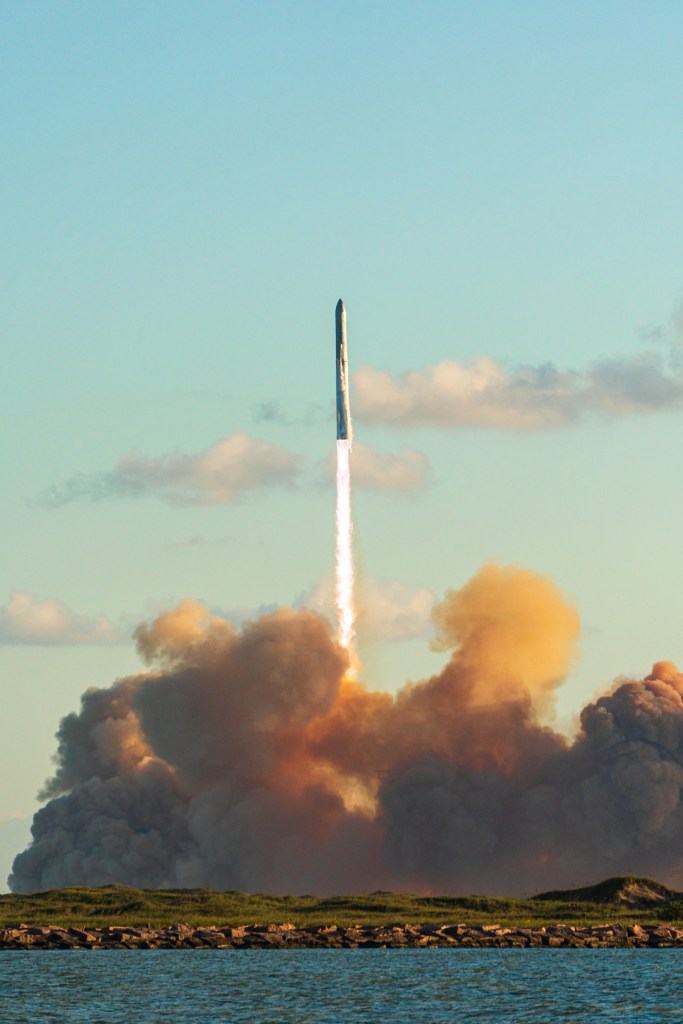
SpaceX launched its fifteenth Starship test flight on Friday, November 13, from Starbase near Boca Chica, Texas. The two-stage vehicle consists of the powerful Super Heavy booster below and the Starship spacecraft—often called Ship—above. After separating from the booster, Ship 42 continued to orbit and deployed 26 Starlink V3 satellites. SpaceX’s mission plan called for roughly 14 orbits and more than 22 hours in space before the spacecraft attempted to return to the same launch site.
On Saturday, November 14, at approximately 3:20 p.m. Central, that plan reached its dramatic conclusion. The spacecraft descended through the atmosphere, slowed under rocket power and was caught by the launch tower’s mechanical arms. It was Starship’s first successful spacecraft catch after an orbital flight. SpaceX had previously caught Super Heavy boosters, but recovering the upper spacecraft from orbit posed a different challenge.
How do you catch a spaceship?
Think of it as five connected engineering problems. Each one has to go right before the last one is even possible.
1. Survive the return. Starship must reduce its orbital speed and endure the heating and aerodynamic forces of atmospheric reentry. Its thermal-protection tiles help shield the vehicle. SpaceX equipped this flight with changes to the heat shield and additional monitoring, including cameras carried on some deployed satellites.
2. Control its orientation. A returning spacecraft is not simply falling straight down. It must manage its attitude and trajectory while descending, first using aerodynamic control and later transitioning to powered flight.
3. Restart the engines and slow dramatically. Near the end of the descent, the spacecraft uses its engines to reduce its velocity and maneuver toward the catch area. This is the moment when a fast-moving vehicle must become slow and precisely controllable.
4. Align with the tower. The enormous launch tower is fitted with two mobile mechanical arms, nicknamed “chopsticks.” Ship must arrive at the proper position and speed so that those arms can support its weight at the intended catching points. The arms do not reach out to snatch a spacecraft traveling at orbital speed; the spacecraft does almost all the hard work before the catch.
5. Transfer the load. Once the arms support the vehicle, the spacecraft’s engines can shut down. Instead of touching down on conventional landing legs, the spacecraft ends its flight suspended by the launch infrastructure.
The tower doesn’t stop an orbiting spaceship. The spaceship first slows itself to an extraordinarily precise arrival.
Where did it happen?
The catch took place at Starbase, SpaceX’s launch complex near Boca Chica on the southern Texas Gulf Coast, not at a floating platform or a California landing site. The spacecraft returned to the launch area where the mission began. That return-to-launch-site capability matters because it could eventually simplify inspection, servicing and reuse.
Why is this such a big deal?
Today most rockets discard major hardware, recover only part of the system, or require complex postflight transport. SpaceX wants both Starship stages to be recoverable and flown again after servicing. Avoiding spacecraft landing legs could also reduce onboard hardware and make it easier for launch-pad equipment to handle the vehicle. But one successful catch does not prove that fully reusable, rapid-turnaround Starship operations are already routine—or that SpaceX has achieved its long-term cost targets.
The technology also matters well beyond the spectacle. Starship is central to SpaceX’s plans for larger satellite missions and is being developed as part of NASA’s future Artemis lunar architecture. Successfully returning Ship from orbit is one step toward those ambitions, not a demonstration of every capability still needed for the Moon.
What did not go according to plan?
Flight 15 was meant to attempt a catch of both stages. The Super Heavy booster’s return-to-tower catch was aborted on Friday, and the booster was lost in the Gulf of Mexico. The precise root cause remains under investigation. So the accurate headline is the first successful orbital Starship spacecraft catch, not “SpaceX recovered the entire rocket.”
That distinction is worth preserving. Experimental flight programs are often a mixture of real breakthroughs, setbacks and unanswered questions. Reporting all three is more useful than treating a spectacular video as proof that every problem has been solved.
What happens next?
Engineers will examine the recovered spacecraft, inspect its heat shield and structures, assess the performance of the catch system, and investigate the booster abort. Future flights will reveal whether SpaceX can repeat the catch reliably and eventually recover both stages during the same mission.
For the rest of us, today offered an unusual sight: a spacecraft that spent nearly a day circling Earth, then returned to the launch tower and was held in place by two giant arms. Sometimes the most exciting part of a spaceflight is not going up. It is figuring out how to come back.
Watch the original mission coverage
See SpaceX’s official Starship Flight 15 mission page and webcast. The footage is SpaceX’s; any Curiofy diagrams or short-video explainers should be clearly labeled as illustrations rather than actual footage. You can also find upcoming science and space events on Curiofy Live.
Full reentry and tower-catch replay
Sources and fact-checking
- SpaceX — Starship Flight 15 mission plan, objectives and watch link
- Associated Press — November 14 report of the successful ship catch and booster loss
- The Verge — November 14 coverage of the tower catch
- Reuters — November 13 mission context and booster result
Keep Exploring
Enjoyed the Starship catch? Continue exploring the astonishing science and engineering behind our universe.
- Voyager 1: Nearly 50 Years From Home — Follow humanity’s farthest spacecraft as it approaches another remarkable milestone.
- What If a Six-Mile-Wide Asteroid Hit Earth Tomorrow? — Discover the science behind a planetary-scale impact.


Leave a Reply