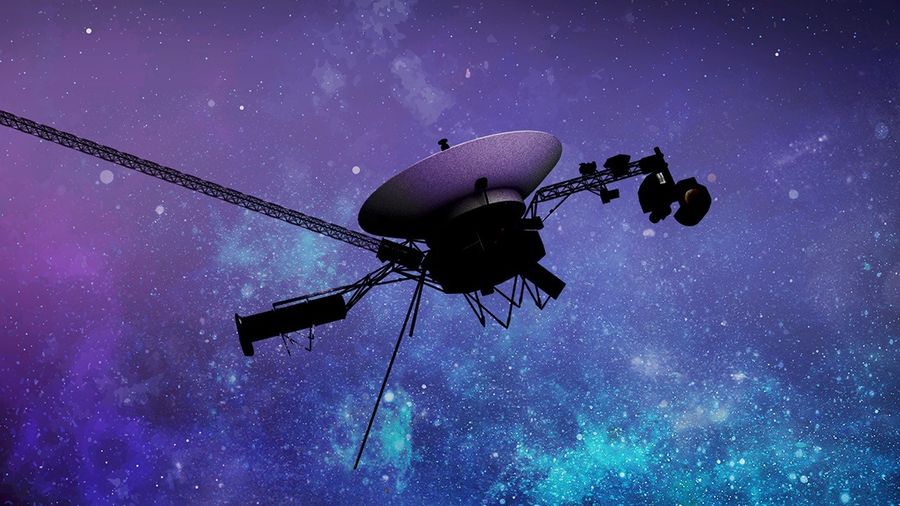
Somewhere beyond the protective bubble of our Sun, a tiny spacecraft is traveling farther from home than anything humanity has ever built.
There are no familiar skies. No one waiting to greet it. Just the immense darkness of interstellar space.
Its computers are ancient. Its power is fading. The people who launched it in 1977 could scarcely have imagined it would still be working nearly 50 years later.
And yet, Voyager 1 keeps going.
On November 18, 2026, NASA predicts this remarkable machine will reach a distance of one light-day from Earth.
Think about what that means. Light travels roughly 186,000 miles every second. But even light will need an entire day to reach Voyager 1.
Send a message from Earth, and it takes about 24 hours to arrive. If Voyager replies immediately, its response needs another 24 hours to return. Two days just to say hello and hear hello back.
And aboard this lonely spacecraft is something extraordinary: a message from Earth. Oceans. Birds. Music. Human voices. Greetings from a world its distant recipients may never know.
Nearly 50 years ago, we sent Voyager 1 to explore the planets. We never imagined how far its story would carry us. And its journey is far from over.
A Journey That Began in 1977
Voyager 1 launched on September 5, 1977, to explore Jupiter and Saturn. It transformed our view of those giant worlds, revealing new moons, rings, and extraordinary details about their atmospheres and satellites.
After its planetary encounters, Voyager continued outward. In August 2012, it crossed the heliopause—the boundary of the Sun’s heliosphere—and became the first human-made spacecraft to enter interstellar space.
What Does One Light-Day Really Mean?
A light-day is a distance, not a time limit or a new physical border. It is how far light travels in 24 hours: about 16.1 billion miles (25.9 billion kilometers).
At that distance, even NASA’s powerful Deep Space Network cannot make a conversation instantaneous. A round-trip radio exchange takes roughly 48 hours, before allowing for processing time.
A Message From Humanity
Voyager 1 carries the Golden Record, a gold-plated copper disc containing greetings in 55 languages, music, sounds of life on Earth, and encoded images of our world.
It is a time capsule designed to communicate something about the people and planet that sent the spacecraft into the unknown. Whether anyone ever discovers it remains an open question.
The Little Spacecraft That Refuses to Quit
The spacecraft has survived decades of intense cold, radiation, and immense distance. Its nuclear power supply gradually produces less electricity, so NASA engineers have had to shut down equipment to preserve the mission.
Even now, Voyager 1 continues to return valuable measurements of the environment beyond the heliosphere. Keeping it operating is an achievement in its own right.
November 18: A Remarkable Milestone
NASA predicts Voyager 1 will reach one light-day from Earth on November 18, 2026. The exact crossing time is a calculation and may be refined; the milestone is not a physical boundary in space.
NASA is inviting people around the world to mark the occasion on November 17 by flashing the spacecraft’s call sign, VGR, in Morse code—a symbolic message of light for a traveler that has carried Earth’s story for nearly half a century.
The Journey Continues
One day, Voyager 1’s instruments will fall silent. Its journey, however, will continue. The spacecraft and its Golden Record may drift between the stars long after its final transmission.
In 1977, humanity launched a machine to explore the planets. Today, that machine has become something more: a messenger from Earth, traveling into a universe we are only beginning to understand.
Stay Curious. Live Better. — Curiofy Life
Sources
NASA: Voyager 1 Mission · NASA: What Is a Light-Day? · NASA: Shine Bright for Voyager


Leave a Reply