November 16, 2026 | Curiofy Life — Science & Space
What would you see if you could look across a patch of the sky and count more than 900 million galaxies? That is now part of the extraordinary scientific catalogue released by the European Space Agency’s Euclid space telescope. And the most important discovery may not be the galaxies we can see—but what their shapes and positions reveal about the invisible Universe.
On November 12, 2026, ESA released Euclid’s first major mission dataset, called DR1-Foundation. It includes roughly 13 months of observations and captures light from more than a billion astronomical objects. The goal is ambitious: build the foundation for a three-dimensional map of the cosmos that helps scientists study dark matter, dark energy and how the Universe evolved.
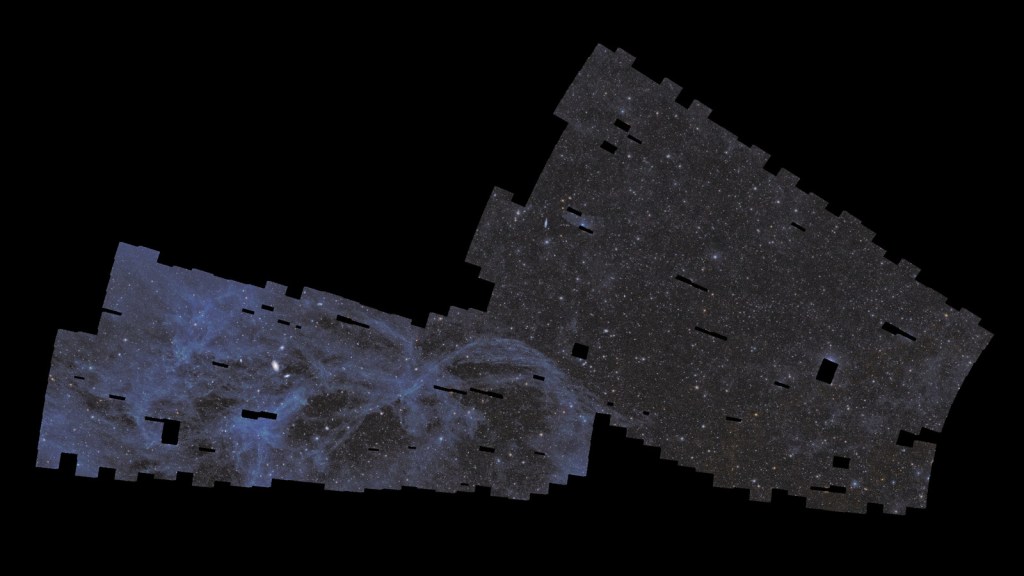
How big is this discovery?
ESA reports more than 900 million galaxies, about 15,000 candidates for strong gravitational lenses, over 60 million quasar candidates and spectra from more than 160 million sources. The wide survey data released so far cover approximately 1,900 square degrees of sky—roughly the area of 9,500 full Moons. These figures describe a vast new research resource, not 900 million brand-new galaxies suddenly appearing in space.
Euclid is designed to study huge numbers of galaxies rather than focus only on a few spectacular objects. That sweeping view allows astronomers to compare how galaxies cluster and how their light has traveled through the Universe over billions of years.
The surprise: invisible matter leaves visible clues
Some distant galaxies appear stretched into arcs, loops or multiple images because the gravity of objects in front of them bends their light. This effect is called gravitational lensing. It gives scientists a way to estimate mass—including matter that does not shine—by measuring what gravity does to the light passing nearby.
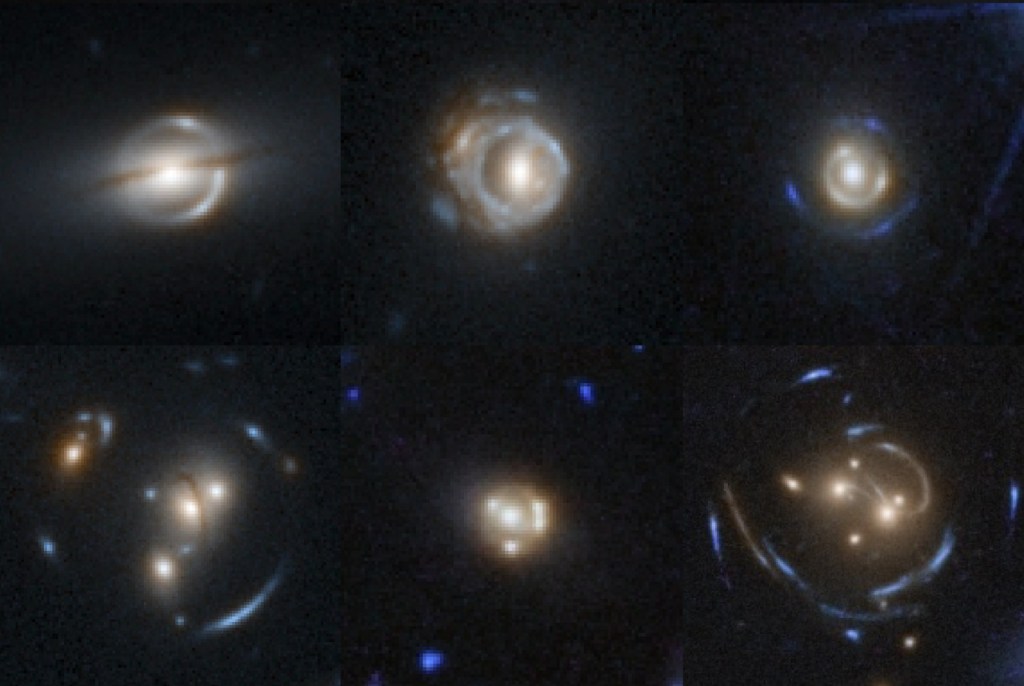
Dark matter has never been directly identified as a particular particle, so an enormous map like Euclid’s cannot simply photograph it. What researchers can do is trace its gravitational influence and compare it with the galaxies and visible matter around it. The new catalogue includes thousands of candidate strong lenses that researchers can study and verify. Candidates are promising leads, not all individually confirmed discoveries.
What about dark energy?
Dark matter and dark energy are not the same thing. Dark matter helps explain gravity’s effects on galaxies and cosmic structure. Dark energy is the name scientists give to the still-mysterious cause associated with the Universe’s accelerating expansion. By measuring the distribution of galaxies and how cosmic structures change, Euclid aims to test models of both.
That means the true payoff will come as astronomers analyze the dataset and assemble more of the map. This is a major data release, not proof that dark matter or dark energy has been solved.
Why this matters for all of us
A telescope observing galaxies billions of light-years away may sound removed from daily life. But Euclid is an example of a powerful scientific idea: measuring something that seems invisible by studying its effects on everything around it. The same curiosity that drives engineering, medicine and astronomy often begins with noticing that the world behaves differently from what we expected.
For an even wider view of the unknown, continue with Curiofy Life’s The Universe We Can’t See: Five Mysteries Hidden in the Night Sky. And if you want to see what one spacecraft can accomplish over decades, explore Voyager 1’s extraordinary journey.
Keep exploring: Curious what dark matter actually is? Read What Is Dark Matter Made Of? The Invisible Mystery Holding Galaxies Together. To see the galaxies behind Euclid’s new cosmic map, watch ESA’s official three-minute fly-through of its 500-gigapixel mosaic (ESA/Euclid/Euclid Consortium/NASA, November 2026).
Explore ESA’s original release
See ESA’s November 12 mission announcement and ESA’s Euclid survey image and data overview. The original ESA imagery has its own credit and licensing terms; this draft links to the official visuals without copying them.


Leave a Reply