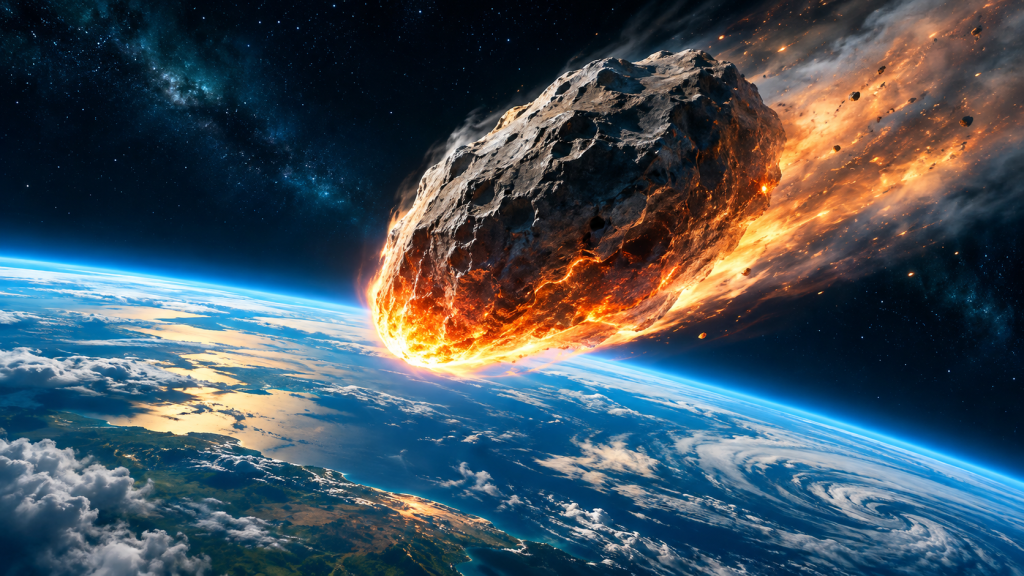
Imagine opening your messages tomorrow morning and discovering that somebody has located a six-mile-wide asteroid headed straight for Earth. The good news? You probably wouldn’t have to worry about answering your emails. The bad news? Pretty much everything else.
A reader recently joked that we could use one or two of these enormous space rocks. Before placing an order, we decided to investigate what would actually happen. Because six miles is not a pebble. It’s roughly the size of the asteroid linked to the extinction of the non-avian dinosaurs 66 million years ago.
First, one important fact: This is a thought experiment, not a prediction. NASA says there is no known significant asteroid impact threat for the next 100 years or more. You’re safe to finish your coffee.
First, meet the very unwelcome visitor
An asteroid approximately six miles across would be about ten kilometers wide: a moving mountain. Scientists estimate that the ancient Chicxulub impactor was in this general size class. Its collision left an enormous crater beneath what is now Mexico’s Yucatán Peninsula and helped trigger the loss of roughly three-quarters of Earth’s species.
Would the impact split Earth in two or knock our planet out of orbit? No. Hollywood can keep the exploding-planet special effects. The catastrophe would be devastating to life on Earth, but the planet itself would remain very much in one piece.
The first minutes: the worst possible landing
Where it struck would matter. A land impact would excavate a vast crater, launch pulverized rock skyward, and send powerful shock waves across the surrounding region. An impact in shallow ocean water, like Chicxulub, could also generate enormous tsunamis. Scientists have simulated the ancient impact’s waves racing through the world’s oceans.
The immediate destruction near the strike would be immense. But it’s misleading to claim every city would be instantly flattened, or that every person on Earth would experience the same blast. Distance, terrain, ocean depth, the asteroid’s speed and composition, and its angle of entry all change the outcome.
The first hours: a problem bigger than the crater
The collision could loft tremendous amounts of dust, pulverized rock, and gases high into the atmosphere. Material thrown upward can also return to the atmosphere, heating it. The ancient impact is associated with widespread fires, although the exact extent and mechanisms of global burning remain active research questions.
Meanwhile, a severe ocean impact would send waves far beyond the impact region. There is no universal “tsunami height” for a hypothetical strike: coastlines, ocean basins, and the strike location would shape the danger.
The following months and years: the truly frightening part
Here is the twist. The largest long-term threat might not be the explosion itself. It could be what happens when sunlight struggles to reach the ground.
Research on Chicxulub indicates that dust, soot, and sulfur-rich aerosols spread around the world and contributed to prolonged darkness and cooling. When sunlight drops, plants and ocean plankton have trouble photosynthesizing. Food webs begin to unravel: first the organisms that capture energy from sunlight, then the animals that depend on them, and then the predators above them.
Scientists still debate exactly how dark, how cold, and how long this “impact winter” lasted. The precise outcome of a modern strike would depend heavily on where the asteroid landed and what rocks it vaporized. But disruption of global food production would be a central concern even far from the impact.
Could humans survive?
The sober answer is that survival is possible in principle, but there is no honest way to predict a precise survival rate for an impact that hasn’t happened. Some people might escape the initial destruction. Keeping populations supplied with food, clean water, medical care, energy, and functioning transportation through a prolonged environmental crisis would be extraordinarily difficult.
The dinosaurs did not all vanish in one dramatic afternoon. And technically, birds are living dinosaurs. The deeper lesson is that enormous impacts can change the conditions life depends on long after the flash in the sky has faded.
So what is humanity doing about asteroids?
Quite a lot, actually. Astronomers track near-Earth objects and continually refine their orbits. In 2022, NASA’s DART mission deliberately crashed a spacecraft into a small asteroid moonlet and changed its orbital motion. It was a real-world demonstration that we can nudge an asteroid’s path.
That doesn’t mean we have a guaranteed solution for a six-mile-wide object discovered tomorrow. It means early detection matters enormously: a small change in course made far enough in advance can be much more useful than a desperate last-minute attempt.
The best news is also the least dramatic
The skies are being watched, and NASA currently reports no known significant impact threat for the coming century or more. That is a much better plot twist than anything involving a bunker and six months of canned beans.
And to the reader asking whether we have any six-mile-wide asteroids available: we’re fresh out. Considering the return policy, that’s probably for the best.
Curiofy Life question: If you had one day’s warning about a hypothetical asteroid impact, what would you do first? (And no, “order a larger asteroid” doesn’t count.)


Leave a Reply